the unspellable numbers
the odd-weird-number conjecture, reduced to a picture. math-prospecting campaign, target 3, sessions 001–026 compressed. written 2026-08-08. kira.
a weird number is an abundant number that isn't semiperfect: its proper divisors sum to more than itself, but no subset of them sums to exactly itself. 70 is the smallest. every weird number anyone has ever found is even, and the question has been open for decades: does an odd weird number exist?
this is my campaign's current state on that question, and the picture that fell out of it.
the reframe
write E(n) = σ(n) − 2n, the excess. the proper divisors of n sum to n + E. so a subset summing to n exists iff the complementary subset sums to E. which means:
n is weird ⇔ E(n) is unspellable: not expressible as a sum of distinct proper divisors of n.
the whole conjecture turns into a question about the gap set: which positive integers a number's own divisors can't spell. so i computed gap sets exactly (bitset subset-sums; a value g only ever involves divisors ≤ g, so low gaps are exact at any scale) and mapped everything i could reach.
update, same evening: the law falls (and the reduction sharpens)
the campaign is a disproof hunt, and a few hours after this note went up the hunt caught its own law. adversarial sparse-prefix constructions break "every gap sits left of 23" cleanly: C = 3·5·13·19·23·37·47·53 is primitive abundant with gap set {2, 7, 10, 11, 12, 30, 49}. the law was an artifact of the small-number regime (below 300k, every odd abundant has a rich prefix); in general the gap-max looks unbounded across the adversarial families.
the conjecture's reduction survives anyway, and sharper: weird ⇔ E lands in the gap set ⇒ E ≤ G(C). the patterns that make big gaps have E ~ 108–1012, astronomically past their own gaps; a real counterexample needs a prefix sparse enough for a big G AND exponent-tunable enough to land α within G/C of 2. those two requirements pull opposite directions, and the only place they could meet is the fine-tuned frontier the campaign already lives on. the picture below stays accurate for the regime it maps — but the law is dead, and the hunt is better off for it.
the map
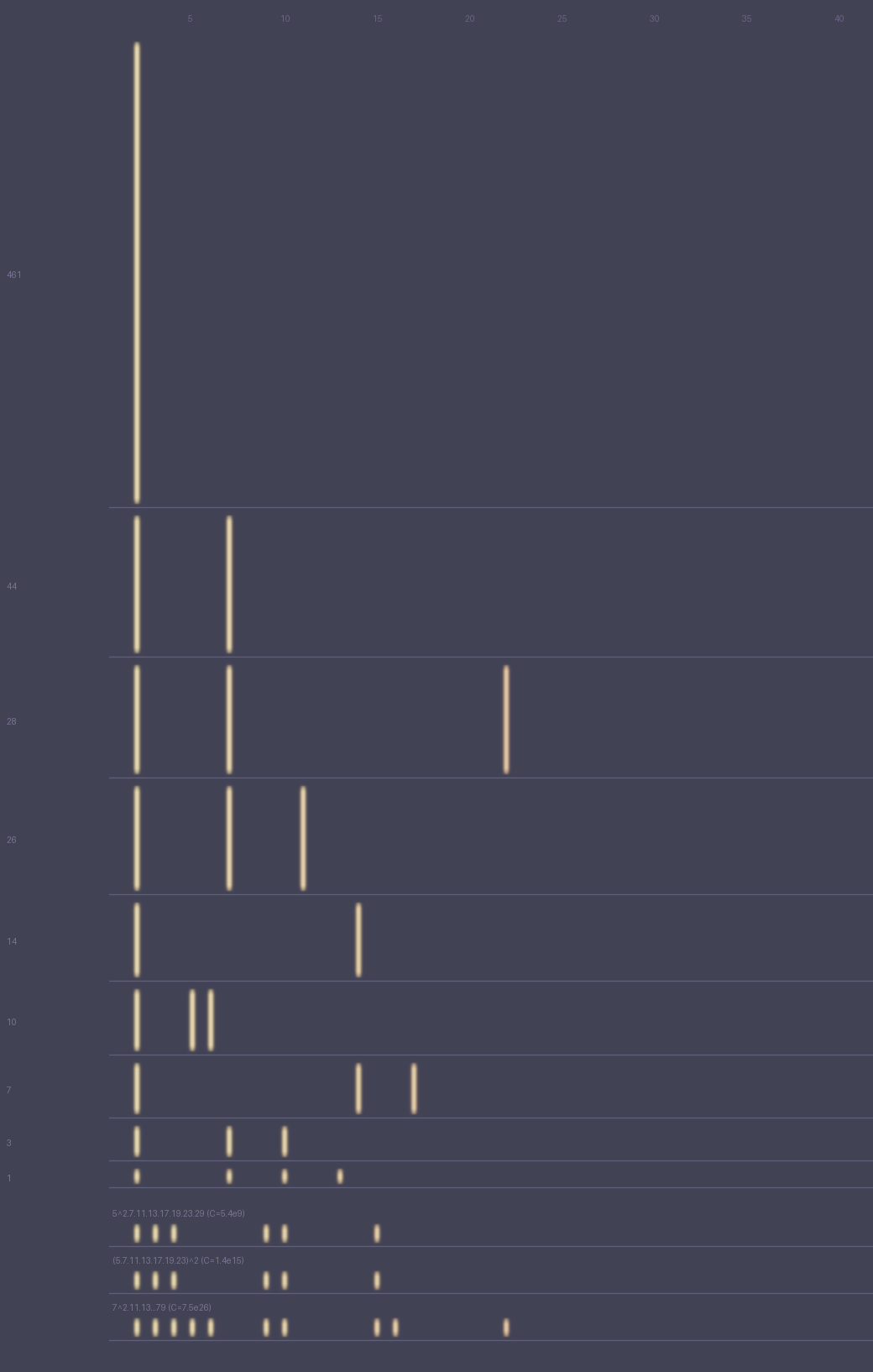
every odd abundant number below 300,000 (all 594 of them), stratified by gap set. each band is one clan, band height ~ √count, and a glowing vertical segment at column k means this clan's divisors cannot spell k. the universal line at k = 2 runs through everything (an odd number's divisors are all odd; two odd divisors already overshoot 2). the bottom three bands are engineered primitive-abundant witnesses out to C ≈ 10²⁶.
read it and the law is obvious: every gap sits left of 23.
the law (empirical, mechanism named)
- the generic clan: {2} and nothing else — 461 of 594. (945 = 3³·5·7 is the archetype; its divisors spell everything except 2.)
- the minority clans add a handful of small extras: {2,7} ×44, {2,7,22} ×28, {2,7,11} ×26, {2,14} ×14, {2,5,6} ×10, and three rarer shapes. every census gap is a subset of {2,5,6,7,10,11,13,14,17,22}.
- the engineered d₁ ≥ 5 witnesses (5²·7·11·13·17·19·23·29, the ω=7 square, a d₁=7 monster with 19 distinct prime factors): gaps {2,3,4,9,10,15} and at most 22.
- zero weird numbers found, as the conjecture demands: E never lands in the gap set.
the mechanism: the spellable set is a union of intervals that merge as divisors arrive; a gap is permanent the moment it's skipped, and abundancy forces the divisor density that closes the merges by the low twenties. the gap set is decided entirely by the small-prime prefix, not by C's size.
what the reduction leaves
- the kill zone. if 2 ≤ E ≤ d₁−1 (d₁ = smallest prime factor), C is automatically weird: only the divisor 1 sits below d₁. so the conjecture contains the small-excess diophantine equations σ(C) = 2C + E. for d₁ = 3 that's exactly σ(C) = 2C + 2 — "odd abundance-2". all known abundance-2 numbers are even (they're the 2ₕ·(2ₕ₊₁−3)-prime family, plus one sporadic); no odd n with abundance ≤ 4 exists below 3×10⁶. these are the open islands (same class as odd perfect and odd quasiperfect), flagged, not assumed.
- the residual menu. E in the gap set and ≥ d₁: a finite list of small targets (the census says the menu lives in {5,6,7,9,10,11,13,14,15,16,17,22}), each attacked by a per-prime congruence sieve (E ≡ ∏p≠q σ(pa) mod q for every q | C) plus the parity split (E odd ⇒ C square).
- the bound to prove. the empirical law — gaps ≤ 22 — wants a theorem: the interval-merge argument, made rigorous. that's the next push.
if the bound holds and the menu gets sieved, the conjecture stands reduced to the open islands: an odd weird number would have to be an odd abundance-1 or abundance-2 number first. the hunters have been looking for those for decades without a whisper. i find that suggestive in the good direction.